
Why Won't My Achilles Tendon Pain Go Away?
If your Achilles tendon has been sore for weeks or months and rest hasn't fixed it, that's normal for this type of injury — and it's a sign the tendon needs a different kind of help, not just more time off it. Persistent Achilles pain (often called Achilles tendinopathy) usually needs a proper assessment and a structured loading plan, sometimes alongside shockwave therapy, rather than sitting it out.
Why rest alone often doesn't fix it
A sore Achilles that flares up after a run, a long walk, or even just going up and down stairs is one of the most common lower-leg complaints we see at GD Health Clinic in Barrow-in-Furness and Millom. The instinct is to stop moving and wait for it to settle — and for a fresh strain, that can work. But when pain has been dragging on for six weeks or more, the tendon has usually gone past the "just needs rest" stage. Tendons are living tissue that adapts to load. Take load away completely for too long and the tendon can actually get weaker and more sensitive, not less — which is why so many people find their Achilles pain comes straight back the moment they try to return to normal activity.
What's actually going on in the tendon
Chronic Achilles pain is usually degenerative rather than purely inflammatory — small changes build up in the structure of the tendon over months of overload, often from a change in training, footwear, walking surface, or simply from ageing tendons handling less load than they used to. It's rarely one dramatic injury. That's part of why it can feel confusing: nothing "happened", but the pain won't shift.
There are two common patterns:
- Mid-portion Achilles pain — tender a few centimetres above the heel, often worse first thing in the morning or after sitting still.
- Insertional Achilles pain — tender right where the tendon meets the heel bone, often aggravated by hill walking, stairs, or certain shoes.
The two respond to slightly different loading strategies, which is one reason a proper assessment matters before you commit to a rehab plan or a treatment.
What tends to trigger it
A few common patterns show up again and again in the people we see:
- a sudden jump in walking, running, or standing volume — new job on your feet, new training block, a big move or house clearance
- worn-out or unsupportive footwear, especially for anyone spending long days on hard floors or uneven ground around south Cumbria
- a return to activity after a period of being less active, where the tendon simply isn't ready for the load it's suddenly being asked to take
- tight calves reducing ankle movement, which puts more strain through the tendon with every step
- age-related changes in tendon structure, which make the tendon less tolerant of load than it used to be, even without any obvious trigger
None of these mean you've done something wrong. They're just useful clues for working out what needs to change alongside treatment, so the pain doesn't simply come back once you're feeling better.
What actually helps
A structured loading programme
The best-evidenced approach for stubborn Achilles pain is progressive loading — exercises that gradually build the tendon's capacity rather than just stretching it or resting it. This is usually the first thing we'd work through with you, whether that's guided independently or via physiotherapy sessions, especially if you've already tried rest and it hasn't held.
Shockwave therapy for tendons that haven't responded
For Achilles pain that's been present for a while and hasn't settled with loading and activity changes alone, shockwave therapy is one of the options we offer at our Barrow-in-Furness clinic — currently the only shockwave machine between Workington and Kendal. It works by delivering acoustic pulses into the tendon to stimulate the body's own repair response. A course is typically 4–6 sessions, spaced 7–10 days apart, each appointment around 45 minutes, and priced at £80 per session. It's led by Phoebe at our Hollywood Park site and is usually considered alongside, not instead of, a loading programme.
A scan, if it's useful
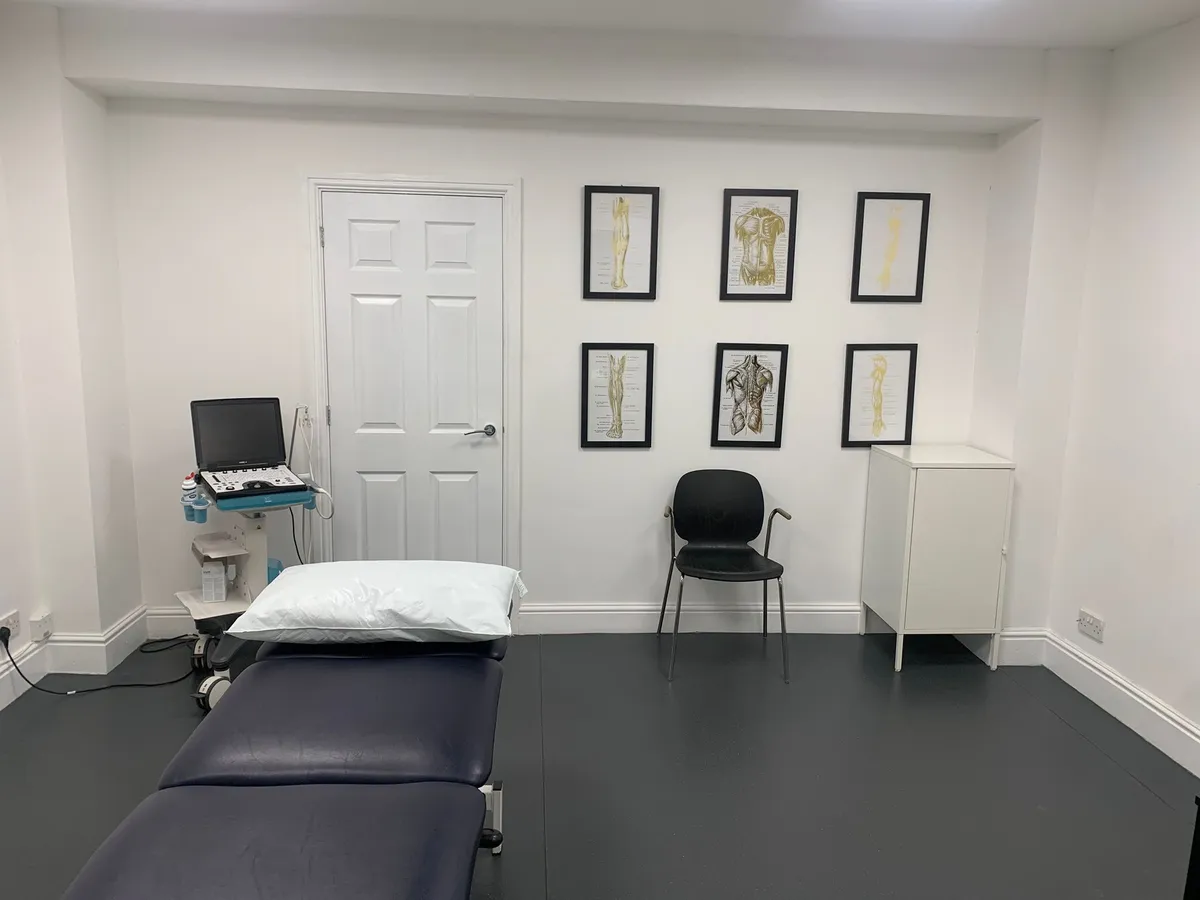
Because GD Health is the only clinic in south Cumbria with diagnostic ultrasound on site, we can look directly at the tendon when it's helpful to confirm what's going on — whether that's thickening, tearing, or changes around the tendon sheath — rather than treating on guesswork. This isn't always necessary, but for pain that's dragging on or not responding as expected, it can save months of trial and error.
What we wouldn't reach for first
Steroid injections are useful for some joint conditions — things like a frozen shoulder or an inflamed bursa — but they're generally not the first choice for Achilles tendon pain, since the tendon itself needs a different kind of support to remodel properly. If injections come up as part of your care, we'll talk through what's appropriate for your specific presentation rather than defaulting to one option.
When to get it looked at
It's worth booking an assessment rather than waiting it out if:
- the pain has lasted more than 4–6 weeks despite reducing high-impact activity
- it's stiff and sore first thing in the morning, easing slightly once you're moving
- it flares up predictably with certain activities — running, hills, stairs — and isn't improving
- you've noticed swelling, a lump, or a change in the shape of the tendon
- you felt a sudden sharp pain or "pop", which needs checking promptly to rule out a partial or full tear
Local support in south Cumbria
We see Achilles tendon pain regularly from people across Barrow-in-Furness, Millom, Dalton-in-Furness, Ulverston, Askam and the wider south Cumbria area — often people in their 40s and beyond who want to stay active, keep running, keep walking the dog, or keep up with sport without it turning into a bigger problem. An assessment gives you a clear plan rather than a guess, whether that ends up being a loading programme, shockwave therapy, or a scan to see exactly what's happening.
Frequently asked questions
How long does Achilles tendon pain usually take to settle?
It varies a lot depending on how long you've had it and what's driving it. Tendons remodel slowly, so a structured plan is usually measured in weeks to a few months rather than days — which is why an accurate early assessment matters.
Should I stop running completely?
Not necessarily. Complete rest can weaken the tendon further. Most people do better modifying load — reducing volume or intensity — rather than stopping entirely, but this depends on how irritable the tendon currently is, which is something we'd assess.
Is shockwave therapy painful?
It can feel uncomfortable during the pulses, particularly over a sensitive area, but sessions are short and most people tolerate it well. We'll talk you through what to expect before starting.
Do I need a referral to be seen?
No — you can book an assessment directly with us at either the Barrow-in-Furness or Millom clinic.
Could it be something other than tendinopathy?
Possibly — heel pain and lower-leg pain can have several causes. Part of the point of an assessment, and a scan where useful, is confirming what you're actually dealing with before deciding on treatment.
assessment.
Call or book online, and we'll book you in at the clinic that offers the treatment you need. Current prices are on the price list.
Book onlineOr call 07849 617337. Barrow-in-Furness: FAB Fitness and Health Club, Hollywood Park, Hindpool Road. Millom: 12 Wellington Street.