
What Causes Ankle Pain That Won't Go Away — And What Actually Helps
Ankle pain that lingers for weeks or months — rather than settling down like a normal sprain — is very often not "just a sprain" that hasn't healed yet. In most cases it's the Achilles tendon, or the soft tissue around the joint, that's become irritated and slow to settle, sometimes alongside old ligament laxity from a sprain that never quite recovered. Working out which of those it is matters, because a tendon problem and a joint problem are treated differently.
Why ankle pain can hang around for months
A straightforward sprain usually heals within a few weeks as the ligament repairs itself. When ankle pain drags on well beyond that, it's usually because something is being repeatedly irritated rather than freshly injured each time — most often the Achilles tendon at the back of the ankle, or tissue around a joint that never fully settled after an old sprain. Both can flare with completely normal daily activity — walking, stairs, standing for long periods — which is why the pain can feel like it's "always there" rather than tied to one clear incident.
This tends to show up most in people in their 40s, 50s and beyond who are still active — walking regularly, still playing sport, or on their feet a lot for work — because the tendon and joint have had decades of load on them and recover more slowly from irritation than they once did. That doesn't mean slowing down is the answer; it usually means the loading needs adjusting rather than stopping altogether, which is where getting a proper opinion earlier rather than later tends to pay off.
What's usually behind it
- Achilles tendinopathy — the tendon connecting your calf to your heel becomes thickened and irritated from years of load, often worse first thing in the morning or after a period of rest
- Old ligament laxity — a sprain that healed with the ligament slightly loose, leaving the ankle prone to rolling and aching under load
- Ankle impingement — bony or soft tissue getting pinched at the front or back of the joint on certain movements, common after repeated sprains
- Early wear in the ankle joint itself — less common than in the knee or hip, but degenerative change can develop in the ankle too, particularly after previous injury
A useful rule of thumb: pain that's worse with the first few steps in the morning and eases once you're moving points more towards the tendon; pain that's there throughout the day and worse on uneven ground points more towards the joint or old ligament damage.
What helps first
For the first few weeks, most people do reasonably well with some sensible self-management:
- Reducing — rather than stopping entirely — the activities that clearly aggravate it
- A supportive, well-fitted shoe rather than flat or worn-out footwear
- Calf and ankle stretching, done little and often rather than in one long session
- Ice after activity if it's been flared up
Where this often goes wrong is either pushing straight through the pain, which keeps re-irritating the tendon, or resting almost completely, which lets the calf and ankle stiffen and can leave the tendon even less tolerant of load when you do get back to activity. A short course of physiotherapy to rebuild the tendon's capacity gradually is usually the more reliable route once a couple of weeks of simple self-management hasn't settled things.
When it needs more than rest and physio
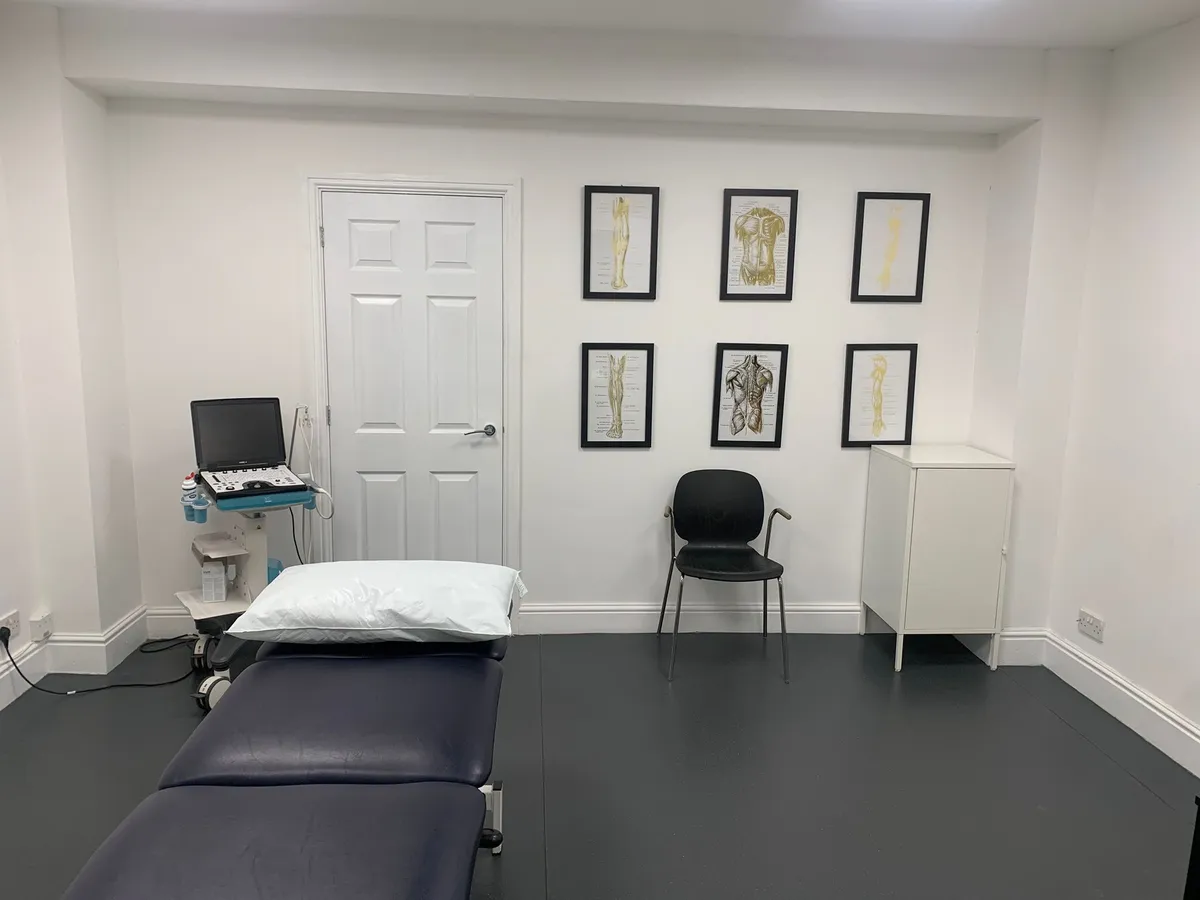
If it's been going on for more than six to eight weeks, or it's bad enough to change how you walk or stop you exercising, it's worth getting it properly looked at rather than continuing to guess. A diagnostic ultrasound scan can show directly whether it's the Achilles tendon, the surrounding soft tissue, or the joint itself that's the problem — GD Health Clinic is the only clinic in south Cumbria offering diagnostic ultrasound alongside ultrasound-guided treatment, so the scan and any treatment that follows can often happen in the same visit rather than a referral and a wait.
For genuine tendon changes that have been dragging on for months, shockwave therapy at our Barrow-in-Furness site — a course of 4-6 sessions, 7-10 days apart, led by Phoebe — targets the stuck, poorly-healing tendon tissue directly rather than masking the pain. Where the scan points more towards the joint itself rather than the tendon, a guided injection may be the more appropriate option instead.
What an assessment at GD Health Clinic looks like
We'll start by looking at how your ankle moves, exactly where it hurts, and the pattern of pain you're describing. If that doesn't give a clear enough picture on its own, we can scan it there and then rather than sending you away to book a scan elsewhere. From there we'll talk through the realistic options — physiotherapy, shockwave, a guided injection, or simply a plan for managing it yourself — with no obligation to book anything beyond the assessment.
Ankle pain support across south Cumbria
We see people with this kind of long-standing ankle pain from right across the area — Barrow-in-Furness, Millom, Dalton-in-Furness, Ulverston and Askam — plenty of them keen walkers, runners and people on their feet all day for work. Shockwave therapy runs from our Barrow-in-Furness site only, but assessments, scans and injections are available across both our south Cumbria locations, so wherever you're travelling in from, an assessment is the sensible place to start.
Frequently asked questions
Is ankle pain that's lasted months still just a sprain?
Usually not. A straightforward sprain tends to settle within a few weeks. Pain that lingers well beyond that is more often the Achilles tendon, surrounding soft tissue, or old ligament laxity than an unhealed sprain.
Why does my ankle hurt more first thing in the morning?
That pattern — worse with the first few steps, easing as you move — is a classic sign of tendon irritation rather than a joint problem, since the tendon stiffens overnight and needs to "warm up" again each morning.
Do I need a scan before treatment?
Not always, but if the pain has lasted more than six to eight weeks a scan makes it far easier to pick the right treatment first time, since tendon problems and joint problems are treated differently.
Is shockwave therapy available at both GD Health sites?
No — shockwave therapy runs from our Barrow-in-Furness site only. Assessments, scans and guided injections are available at both Barrow-in-Furness and Millom.
How long does shockwave therapy take to work?
It's delivered as a course, typically 4-6 sessions spaced 7-10 days apart, rather than a single treatment — most people are advised to judge progress across the course rather than after just one session.
Can I keep walking or exercising while it's being treated?
Usually yes, within limits — the general approach is to keep moving but reduce whatever specifically aggravates it, rather than stopping activity altogether. Your assessment will cover what's sensible to keep doing and what's worth easing off while things settle.
assessment.
Call or book online, and we'll book you in at the clinic that offers the treatment you need. Current prices are on the price list.
Book onlineOr call 07849 617337. Barrow-in-Furness: FAB Fitness and Health Club, Hollywood Park, Hindpool Road. Millom: 12 Wellington Street.