
What Helps Bursitis Pain in the Hip or Shoulder?
Bursitis pain usually settles with rest, ice, activity changes and physiotherapy first. If it's still there after a few weeks, or it keeps coming back, a steroid injection into the bursa is often the next step — it's a targeted, fast-acting anti-inflammatory that can calm things down enough to get moving again. A scan first makes sure it's actually the bursa causing the pain and not something else nearby, like a tendon.
What is bursitis, and why does it flare up in the hip or shoulder?
A bursa is a small fluid-filled cushion that sits between bone and the soft tissue moving over it — tendon, muscle or skin. There are bursae dotted around most of the body's joints, but the ones that cause the most trouble sit over the point of the hip (the greater trochanter) and inside the shoulder, tucked under the shoulder blade muscle.
When a bursa gets irritated — from repetitive movement, a change in activity level, direct pressure (lying on that hip at night, for example), or as a side effect of a tendon problem nearby — it becomes inflamed and swells. That's bursitis. It tends to show up as a localised ache that's worse with specific movements or positions: lying on the affected hip, reaching overhead, or pressing directly on the sore spot.
What does bursitis pain actually feel like?
- Hip bursitis — an ache on the outside point of the hip, often worse lying on that side at night, worse climbing stairs, and sometimes spreading down the outside of the thigh.
- Shoulder bursitis — pain reaching overhead or out to the side, often worse at night, and easy to confuse with a rotator cuff tendon problem because the symptoms overlap so closely.
That overlap with tendon pain is exactly why a diagnosis matters before treatment starts — bursitis and tendinopathy don't always respond to the same things, and guessing wastes time.
What causes bursitis in the first place?
Bursitis is rarely caused by one single event. More often it builds up from one or more of the following:
- Repetitive movement — decorating, gardening, a job that involves a lot of overhead reaching or kneeling, or a sudden jump in training volume for a sport.
- Direct pressure — leaning on an elbow at a desk, kneeling on hard floors, or consistently sleeping on the affected hip.
- A nearby tendon problem — in the shoulder especially, an irritated rotator cuff tendon can inflame the bursa sitting right next to it, so the two often turn up together.
- Age-related change — bursae, like tendons, become a little less tolerant of load as we get into our 40s, 50s and beyond, which is part of why bursitis becomes more common with age.
- Underlying joint conditions — arthritis or gout elsewhere in the body can occasionally make bursitis more likely, though this isn't the case for most people.
Knowing which of these applies matters, because treating the bursa alone without addressing what's aggravating it — a work task, a sleeping position, a training load — makes it more likely to come back.
Self-care worth trying before you book an assessment
For pain that's just started, or is clearly linked to a specific activity, these are reasonable first steps:
- Ease off — or temporarily stop — whatever seems to be aggravating it.
- Ice the area for 10–15 minutes a few times a day in the first week.
- Change sleeping position if it's hip bursitis flaring up at night — a pillow between the knees, or sleeping on the other side, takes pressure off the point of the hip.
- Simple over-the-counter pain relief, used as directed, can take the edge off while it settles.
If pain hasn't noticeably improved after two to three weeks of this, or it's severe enough to disturb sleep every night, that's a reasonable point to get it looked at properly rather than continuing to wait it out.
What helps bursitis pain — the usual order
1. Activity changes, ice and time
Mild, recent bursitis often settles by easing off whatever's aggravating it — changing sleeping position, adjusting a repetitive movement at work or in sport — plus ice and simple pain relief. Several weeks is a reasonable trial before assuming it needs more.
2. Physiotherapy
If it isn't settling, physiotherapy looks at what's driving the irritation — often weakness or tightness in the muscles around the joint — and builds a plan to offload the bursa while it calms down. This is usually tried before, or alongside, an injection.
3. A scan, if the diagnosis isn't clear
Bursitis, tendon pain and other causes of hip or shoulder pain can feel similar from the outside. A diagnostic ultrasound scan shows what's actually happening at the joint — whether it's the bursa, a tendon, or both — before committing to a treatment plan.
4. A steroid injection
For bursitis that hasn't settled with the above, a steroid injection directly into the inflamed bursa is a well-established option. It's a targeted anti-inflammatory, delivered precisely to the bursa itself rather than taken as a tablet, and it's one of the treatments GD Health Clinic offers for exactly this kind of joint pain.
What happens at an assessment
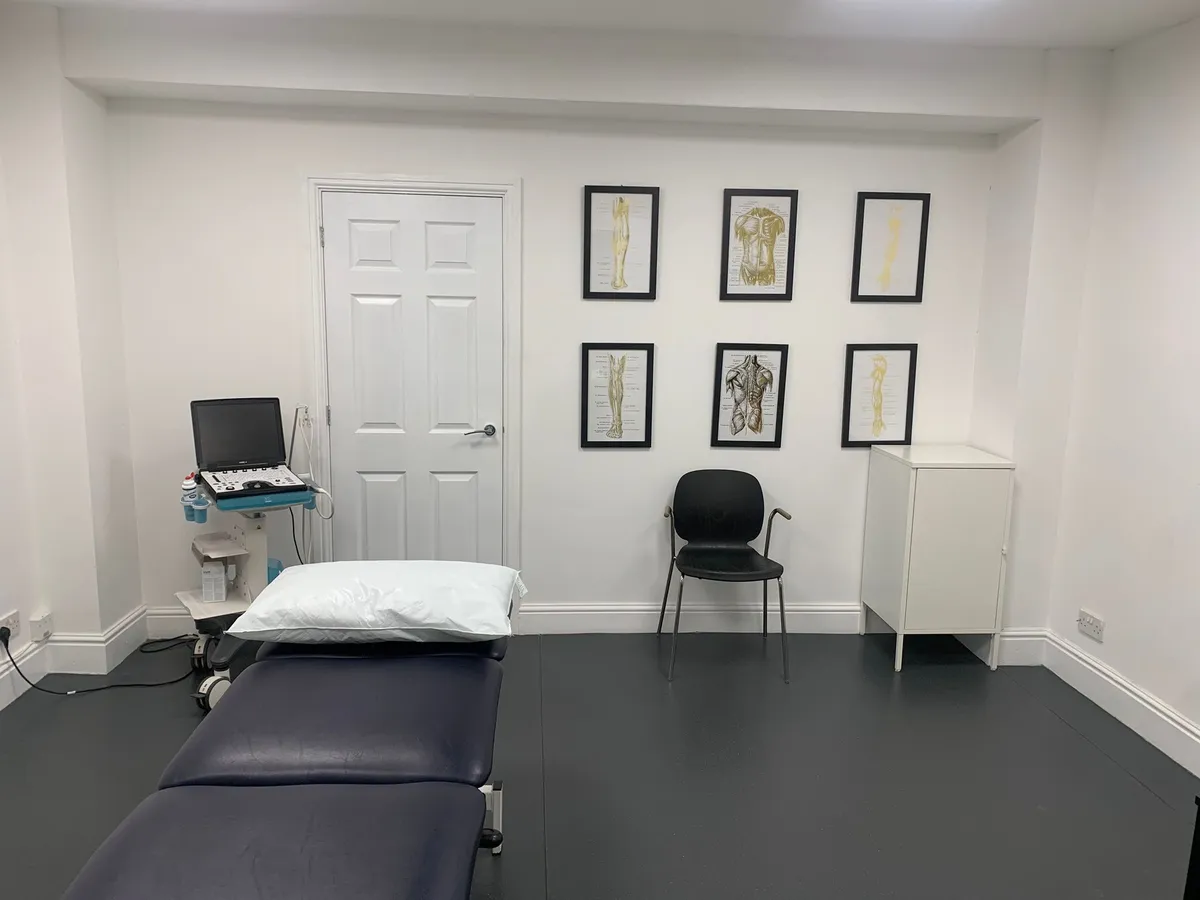
An assessment starts with a conversation — where the pain is, what makes it better or worse, what's changed recently in work, sport or sleep — followed by a physical examination of the joint. If the diagnosis isn't obvious from that alone, a diagnostic ultrasound scan is used to look directly at the bursa and the surrounding tendons and confirm what's actually going on. From there, the options are talked through together, with no obligation to book anything further on the day.
Where to get this checked in south Cumbria
GD Health Clinic is the only clinic in south Cumbria offering diagnostic ultrasound alongside joint injections, so a hip or shoulder that's been sore for weeks can be scanned and treated at the same clinic rather than referred elsewhere. Assessments run from the Barrow-in-Furness site at FAB Health and Fitness club, Hollywood Park, and the Millom site at 12 Wellington Street — convenient for patients across Barrow, Millom, Dalton-in-Furness, Ulverston and Askam who'd otherwise be looking at a trip out of the area.
Read more about our services, including steroid injections and diagnostic ultrasound.
Frequently asked questions
How long does bursitis take to settle?
It varies a lot depending on the cause and how long it's been going on. Mild cases can ease within a few weeks of activity changes and rest; more stubborn cases that have been present for months usually need physiotherapy or an injection to make real progress.
Is bursitis the same as arthritis?
No. Arthritis affects the joint surfaces themselves, while bursitis affects a fluid-filled cushion near the joint. They can occur together, and pain from one can sometimes mimic the other, which is part of why an accurate diagnosis matters.
Do I need a scan before an injection?
Not always, but if the diagnosis isn't clear-cut — especially with shoulder pain, where bursitis and tendon problems overlap — a scan first means the injection goes exactly where it needs to.
Can bursitis come back after a steroid injection?
It can, particularly if the underlying cause — a repetitive movement, muscle weakness, or sustained pressure on the area — isn't addressed alongside it. That's why physiotherapy is often recommended together with, or after, an injection.
Is bursitis linked to arthritis in the same joint?
Bursitis and arthritis can happen independently or alongside each other in the hip or shoulder, and having one doesn't mean you have the other. An assessment is the reliable way to tell which is driving the pain.
assessment.
Call or book online, and we'll book you in at the clinic that offers the treatment you need. Current prices are on the price list.
Book onlineOr call 07849 617337. Barrow-in-Furness: FAB Fitness and Health Club, Hollywood Park, Hindpool Road. Millom: 12 Wellington Street.