
What Helps Chronic Tendon Pain When Rest Hasn't Worked?
Why rest stops working after a while
Most people's first move with a sore tendon is sensible: stop doing the thing that hurts, wait, hope it settles. For a fresh strain that often works. But if the pain has been hanging around for more than six to eight weeks — flaring with activity, easing a bit with rest, then coming straight back the moment you pick the activity back up — rest on its own has usually stopped being the answer.
That's not because you haven't rested enough. It's because chronic tendon pain isn't really an inflammation problem anymore, and rest is an anti-inflammation strategy.
What's actually going on in the tendon
Tendons are rope-like structures that transmit force from muscle to bone. When one is overloaded repeatedly — a shoulder doing overhead lifting, an elbow gripping and twisting, an Achilles taking mile after mile of running — the fibres inside start to break down faster than the body can repair them. Early on that shows up as inflammation, which is why rest and ice help at first.
Left unresolved, the tendon tissue itself starts to change: the fibres become disorganised and the tendon loses some of its normal structure. This is usually called tendinopathy. It's a structural, slow-healing problem, not a flare-up you can wait out — which is exactly why so many people describe the same pattern: weeks or months of on-off rest with the pain never fully going away.
Common places this shows up
The pattern is the same whichever tendon is affected. Locally, we see it most often at:
- the outside of the elbow (tennis elbow)
- the Achilles, especially in runners and walkers
- the shoulder tendons, with pain lifting the arm or reaching overhead
- the patellar tendon, just below the kneecap
- the plantar fascia under the heel, which behaves in a very similar way to a tendon
Whichever one it is, the question we hear is usually the same: "I've rested it for weeks — why hasn't it settled?" And the pattern behind it is usually the same too: pain that came on gradually rather than from one clear injury, a job or hobby with repetitive movement behind it, and weeks of stop-start rest that never quite lets it go.
Why "just rest it more" keeps failing
It's a reasonable instinct, and it's not wrong exactly — it's incomplete. Rest removes the aggravating load, which does calm things down in the short term. The problem is that a tendon which has already started to change structurally doesn't rebuild itself just because it's been left alone. Tendons are relatively low-blood-supply tissue, so healing is slow at the best of times, and without some form of stimulus to trigger repair, a chronically painful tendon can sit in the same weakened state for months. That's why the cycle so often looks like: rest, feel better, go back to normal activity, pain returns almost immediately — because nothing about the tendon's condition actually changed while it was resting.
What actually helps once it's chronic
Loading it properly, not just resting it
Counterintuitively, tendons that have become chronically painful generally need controlled loading to heal — not complete rest. A structured, progressive exercise programme, usually built around slow, resisted movements, stimulates the tendon to remodel and strengthen. This is normally where physiotherapy comes in: getting the loading right so you're stressing the tendon enough to trigger repair without aggravating it. Complete rest, ironically, can leave the tendon deconditioned and no further forward.
What this looks like in practice varies by tendon — a slow heel raise programme for an Achilles, a weighted wrist extension routine for tennis elbow, a controlled squat and step programme for a patellar tendon — but the principle is consistent: gradual, measured load, reviewed and progressed over weeks rather than days.
Shockwave therapy for tendons that haven't responded
When a tendon has been painful for months and hasn't moved on with rest, activity modification and a loading programme, shockwave therapy is often the next step. It uses acoustic shockwaves delivered through the skin to stimulate blood flow and the body's own repair response in stubborn, poorly-healing tendon tissue — it's specifically aimed at the kind of long-standing, "won't budge" tendon pain that hasn't responded to more conservative measures.
At GD Health Clinic, shockwave therapy is available at our Barrow-in-Furness clinic (it isn't currently offered at Millom), led by Phoebe. Sessions are around 45 minutes, £80 each, and a typical course is 4-6 sessions spaced 7-10 days apart — enough time between sessions for the tendon to respond before the next one.
A scan first, if it's useful
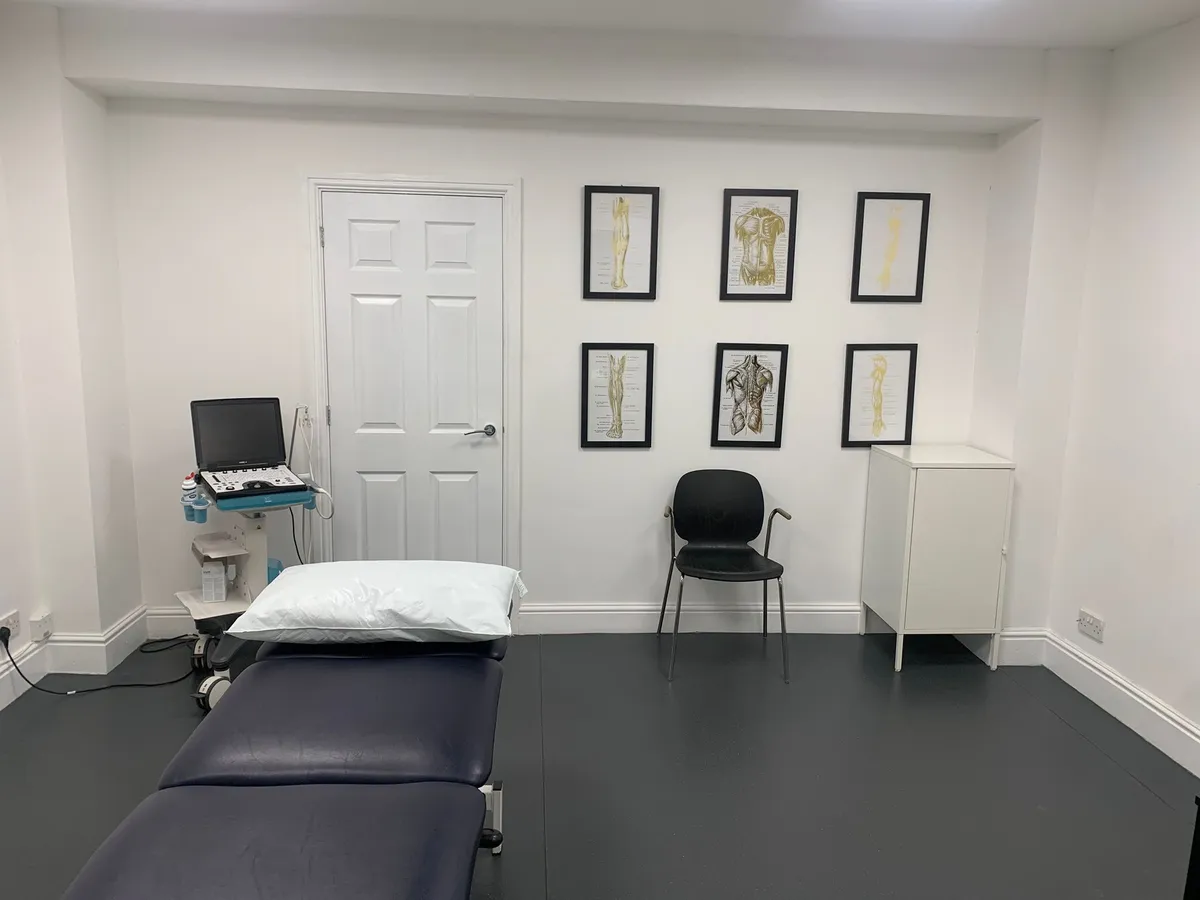
Because tendon pain, bursitis, and joint pain can feel similar from the outside, it's sometimes worth confirming exactly what's going on before starting treatment. We're the only clinic in south Cumbria offering diagnostic ultrasound alongside ultrasound-guided injections, so where it's useful, we can see the tendon on screen rather than guess from symptoms alone. It isn't needed for every case, but for pain that's been going on for months, or hasn't responded to a first course of treatment, it can save time.
What we wouldn't reach for first
Steroid injections can calm inflammation quickly, but for chronic tendinopathy — where the problem is structural rather than purely inflammatory — they're generally not the first choice, and repeated injections into a tendon can weaken it further. They have a place for some presentations, but for a tendon that's been grumbling for months, loading and shockwave tend to be the more appropriate route. This is exactly the kind of judgement call worth making at an assessment rather than guessing.
When to get it looked at
Worth getting assessed rather than continuing to wait it out if:
- the pain has lasted more than six to eight weeks
- it keeps coming back every time you resume normal activity
- rest helps a little but never fully clears it
- it's starting to limit what you can do at work, in sport, or day to day
In the meantime
While you wait to be seen, avoiding the specific movement that reproduces the pain — rather than resting completely — tends to be a sensible middle ground. Gentle, pain-free movement of the area, and staying generally active elsewhere, is usually better than immobilising it entirely. Ice can take the edge off after activity, but it won't change the underlying tendon condition on its own, which is why it's worth booking an assessment rather than relying on it long-term.
Local support in south Cumbria
We see this pattern regularly across Barrow-in-Furness, Millom, Dalton-in-Furness, Ulverston and Askam — it's one of the most common reasons people come in. Physiotherapy is available at both our Barrow and Millom clinics; shockwave therapy is Barrow only for now, run from our clinic at FAB Health and Fitness club, Hollywood Park. For anyone in Millom, Dalton, Ulverston or Askam with a tendon that's been dragging on, the assessment itself is still available locally at 12 Wellington Street, Millom — the shockwave course, if that's the right next step, is a short trip to Barrow.
Frequently asked questions
How do I know if it's tendon pain or something else?
Tendon pain typically sits at a specific point, is worse at the start of activity, eases as you warm up, then aches afterwards. If you're not sure, an assessment — with a scan if useful — will confirm it rather than leave you guessing.
Is shockwave therapy painful?
It can feel uncomfortable during the session, particularly over a sensitive area, but it's brief and most people tolerate it well. Discomfort typically settles quickly afterwards.
Do I need to stop exercising completely?
Usually not, and often complete rest isn't the answer anyway. We'll normally guide you towards adjusted, tolerable loading rather than full stop.
How long before chronic tendon pain actually improves?
It varies by tendon and how long it's been going on, but because this is a structural repair process rather than a flare-up, it's usually measured in weeks and months rather than days — which is why getting the approach right early matters.
Do I need a GP referral to be seen?
No — you can book an assessment directly with us.
Can I have shockwave and physiotherapy together?
Yes — for a lot of people that's the most effective combination. Shockwave stimulates the tendon's repair response; the loading programme gives it something structured to rebuild against. We'll talk through whether one, or both, makes sense for you at the assessment.
assessment.
Call or book online, and we'll book you in at the clinic that offers the treatment you need. Current prices are on the price list.
Book onlineOr call 07849 617337. Barrow-in-Furness: FAB Fitness and Health Club, Hollywood Park, Hindpool Road. Millom: 12 Wellington Street.