
Shoulder Pain When You Lift Your Arm: What's Causing It and What Helps
Shoulder pain that flares specifically when you lift your arm — reaching overhead, putting on a coat, or lifting something off a high shelf — is most often caused by rotator cuff impingement or bursitis, where the tendons and a small fluid-filled sac get pinched as the arm moves through a certain range. It's usually not the shoulder joint itself that's damaged; it's a mechanical squeeze happening at a specific angle, which is why the pain often has a clear "painful arc" rather than hurting all the time.
Why it hurts specifically on lifting
The shoulder is a shallow ball-and-socket joint held together largely by soft tissue — the rotator cuff tendons, a bursa (a small cushion that reduces friction), and the surrounding muscles. When you lift your arm out to the side or overhead, the space between the top of the arm bone and the bony arch above it narrows. If the tendons or bursa are even slightly swollen — from years of overhead work, gardening, decorating, sport, or just general wear — that narrowing is enough to pinch them, and you feel it as a sharp catch or ache somewhere between 60 and 120 degrees of lifting.
Below that arc, and often above it once the arm is fully raised, there's usually little or no pain — it's that middle range that catches people out, and it's a useful clue when working out what's actually going on.
What's usually behind it
- Rotator cuff tendinopathy or impingement — the tendons have become irritated or thickened from repeated overhead movement
- Subacromial bursitis — the cushioning sac between the tendon and the bone has become inflamed and swollen
- A partial rotator cuff tear — more likely if the pain came on suddenly after a specific lift or fall, or if the arm feels genuinely weak rather than just painful
- Calcific tendinitis — calcium deposits forming within the tendon, which can cause a sharper, more intense flare
It's worth ruling out frozen shoulder too, but that tends to look different — frozen shoulder restricts movement in every direction, including passively when someone else moves your arm for you, whereas impingement-type pain usually has a fuller range once you get past the painful arc.
What helps first
For the first few weeks, most people do reasonably well with some sensible self-management:
- Avoiding the specific movements that trigger the pain, rather than resting the arm completely
- Gentle range-of-movement exercises to stop the shoulder stiffening up around the problem
- Ice after activity if it's been aggravated
- Over-the-counter anti-inflammatories, if suitable for you, for a short period
Where this often goes wrong is people either push straight through the pain (which keeps re-irritating the tendon) or stop using the arm almost entirely (which lets the shoulder stiffen and can drag out recovery). A short course of physiotherapy to correct the loading pattern — often it's a postural or shoulder-blade control issue driving the impingement, not just the tendon itself — is usually the more reliable route once simple rest hasn't settled things within a couple of weeks.
When it needs more than rest and physio
If the pain has been going on for more than six to eight weeks despite physiotherapy, or it's bad enough to disturb your sleep or stop you working, it's worth getting it properly assessed rather than continuing to guess. At that point there are two things that tend to make the biggest difference:
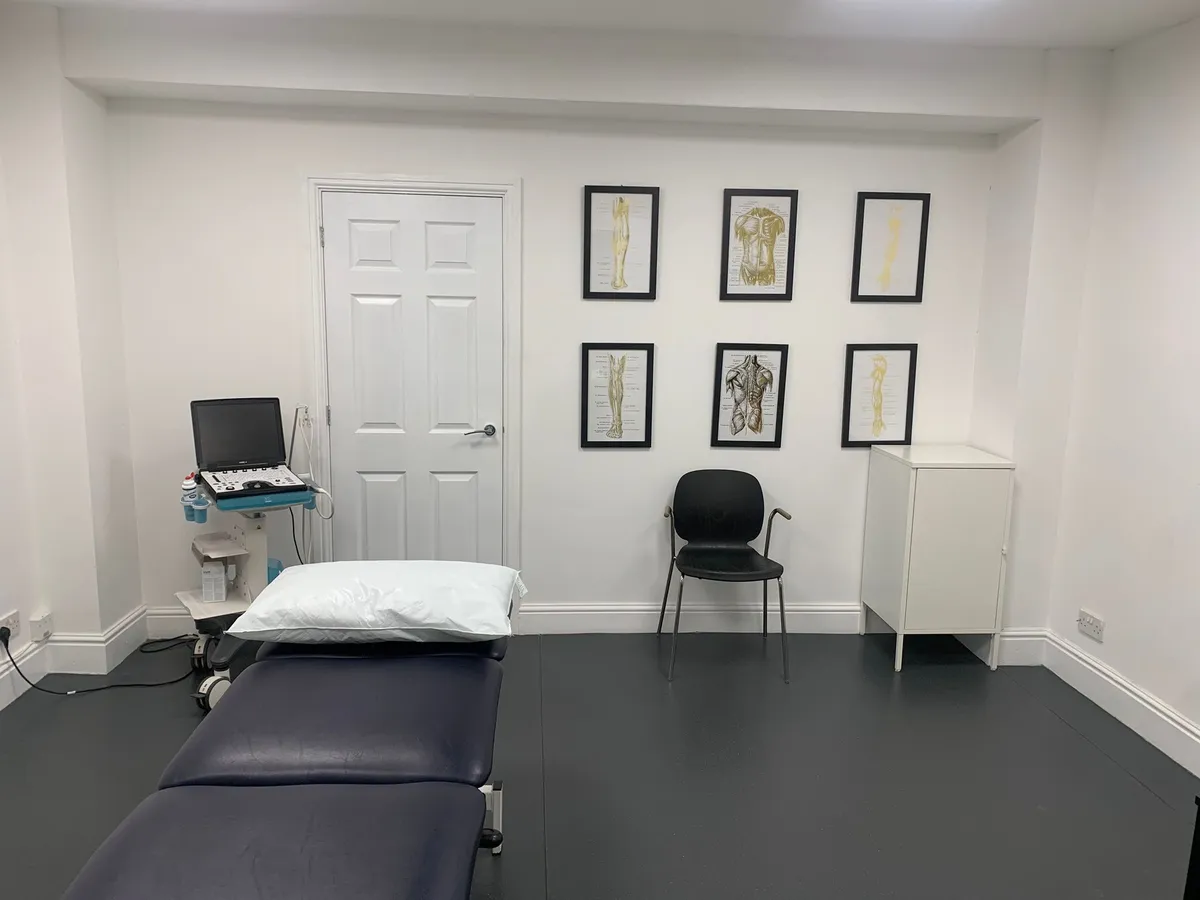
A diagnostic ultrasound scan can show directly whether it's bursitis, tendon thickening, a partial tear or calcific deposits causing the problem — which matters, because the right next step depends on which of those it actually is. GD Health Clinic is the only clinic in south Cumbria offering diagnostic ultrasound alongside ultrasound-guided treatment, so the scan and the injection, if one's appropriate, can be done as part of the same visit rather than a referral and a wait.
Where there's a genuinely inflamed bursa or tendon sheath, a guided steroid injection can calm that inflammation down quickly and give the shoulder a window to rehab properly, since it's hard to make progress with exercises while everything is still acutely inflamed. For longer-standing tendon changes rather than active inflammation — tendinopathy that's been dragging on for months — a course of shockwave therapy at our Barrow-in-Furness site is often the more appropriate option, since it targets stuck, poorly-healing tendon tissue rather than active swelling.
What an assessment at GD Health Clinic looks like
You'll start with a proper look at how your shoulder moves — which angles trigger it, how strong the arm is, and whether the pattern points to impingement, bursitis or something else. If the picture isn't clear from that alone, we can scan it there and then rather than sending you away to book a scan elsewhere. From there we'll talk through what's actually going on and the realistic options, whether that's a course of physiotherapy, a guided injection, shockwave, or simply a plan for managing it yourself — there's no pressure to book more than an assessment.
Shoulder pain support across south Cumbria
We see people with this kind of shoulder pain from right across the area — Barrow-in-Furness, Millom, Dalton-in-Furness, Ulverston and Askam — a lot of it from people whose jobs or hobbies involve a fair bit of overhead lifting or reaching: tradespeople, gardeners, keen swimmers and gym-goers among them. If you're travelling in from further afield, an assessment is the sensible starting point so any scan or treatment plan can be arranged in the same visit.
Frequently asked questions
Why does my shoulder only hurt when I lift my arm to the side?
That's the classic "painful arc" of rotator cuff impingement or bursitis — the pain sits in a specific range, usually roughly 60-120 degrees, because that's where the tendon or bursa gets pinched. Pain that's constant in every position points more towards something else, like frozen shoulder or a joint problem.
Should I keep using my arm or rest it completely?
Generally, avoid the specific movement that triggers the pain rather than resting the whole arm. Complete rest often lets the shoulder stiffen up, which tends to make things harder to shift, not easier.
How do I know if it's a tear rather than just irritation?
A tear is more likely if the pain started suddenly with a specific lift, fall or wrench, or if the arm feels genuinely weak rather than just sore. A scan is the only reliable way to tell the difference for certain.
Will a steroid injection fix it permanently?
A steroid injection calms down inflammation and eases pain, which can give you a window to make progress with rehab, but it doesn't correct the underlying loading pattern on its own — that's usually where physiotherapy comes in alongside it.
Do I need a referral to get a scan?
No — at GD Health Clinic you can book a diagnostic ultrasound scan directly, and if a guided injection turns out to be appropriate, it can often be done in the same appointment.
assessment.
Call or book online, and we'll book you in at the clinic that offers the treatment you need. Current prices are on the price list.
Book onlineOr call 07849 617337. Barrow-in-Furness: FAB Fitness and Health Club, Hollywood Park, Hindpool Road. Millom: 12 Wellington Street.