
Can Shoulder Tendon Pain Heal Without Surgery?
Yes — most shoulder tendon pain settles without surgery. The usual path is rest from the movement that aggravates it, targeted physiotherapy, and, if it's not settling after a few weeks, a guided injection to calm the inflammation down so rehab can actually work. Surgery is only really on the table when a tendon is significantly torn or nothing else has helped after a proper trial of treatment.
What's actually causing the pain?
"Shoulder tendon pain" usually means one of a small group of things: rotator cuff tendinopathy (wear and irritation in the tendons that lift and rotate your arm), subacromial impingement (the tendon getting pinched as you lift your arm), or bursitis (the fluid-filled cushion above the tendon getting inflamed). They tend to cause similar symptoms — an ache that's worse at night, catching or weakness when you reach overhead, and pain when lifting your arm to the side.
The tricky part is that these three overlap, and what helps one can do very little for another. That's usually where people get stuck: they've tried "everything" but never actually knew which of the three they were dealing with.
Why it happens
Shoulder tendon pain is common from the mid-40s onward, when the tendons naturally lose some of their elasticity and become more reactive to load. It's not usually a single injury — most people can't point to one specific moment it started. Instead it builds up from repeated overhead movement: decorating, gardening, gym work, lifting at work, racket sports, or simply sleeping on the same side every night. Manual jobs and anything involving reaching above shoulder height day after day raise the risk, which is why it comes up so often in occupational health assessments as well as general clinic visits.
None of this means damage is inevitable — it just means the tendon has less tolerance for sudden increases in load than it used to. Understanding that is part of why generic rest often doesn't fix it: the tendon needs graded loading, not just time off.
What helps first
Before any talk of injections, most shoulder tendon pain responds to the basics done properly:
- Activity modification — not full rest, but cutting out the specific overhead or repetitive movement that's winding the tendon up
- Physiotherapy — a graded loading programme for the rotator cuff and shoulder blade muscles, which is the single most evidence-backed thing for tendon pain
- Sports massage — useful for the surrounding muscle tightness (upper trapezius, pec minor) that often makes shoulder mechanics worse
Given a proper 6-8 week run, this resolves a large proportion of shoulder tendon pain on its own. The problem is pain that's too sharp or too constant to let you do the loading exercises properly — that's usually the signal to look at what's actually going on inside the joint.
What a first assessment actually involves
An assessment starts with a straightforward physical exam — checking your range of movement, which specific movements reproduce the pain, and how the shoulder blade and surrounding muscles are working. That alone narrows down whether you're looking at tendinopathy, impingement, bursitis, or something else entirely, like referred neck pain, which can feel similar but needs a completely different approach.
If the picture isn't clear from the exam, or if pain has been going on for more than a few weeks without improving, that's when a scan gets added — done in the same appointment rather than referred out. From there you leave with an actual diagnosis and a plan, rather than a generic "try some physio and see how it goes."
When a scan is worth it
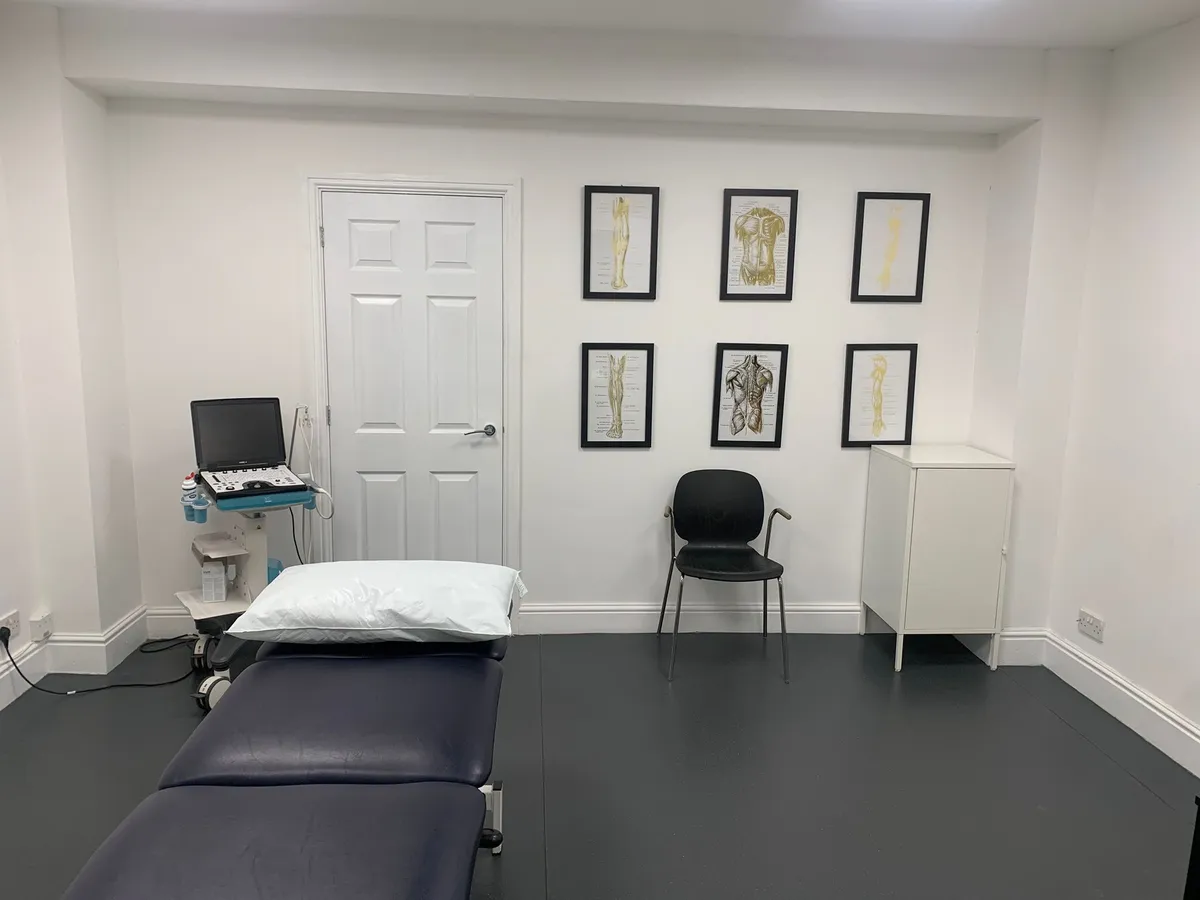
A diagnostic ultrasound scan is the quickest way to see what's actually driving the pain — whether it's tendon thickening, a bursa that's inflamed, a partial tear, or just irritation with nothing structurally wrong. GD Health is the only clinic in south Cumbria with in-house diagnostic ultrasound, so instead of guessing or waiting weeks for an NHS scan, you can see the joint and get a plan the same visit.
Steroid injections for shoulder tendon and bursa pain
When pain is too high to progress with physio, or a scan shows an inflamed bursa or subacromial impingement, a guided steroid injection is usually the next step. It's a targeted anti-inflammatory injection into the affected area — for shoulders, that's most often the subacromial bursa or, for a genuinely frozen shoulder, the joint capsule itself. At GD Health it's given ultrasound-guided, so the needle is placed exactly where it needs to be rather than by feel.
It doesn't fix the underlying tendon on its own — think of it as calming things down enough that physiotherapy can do the rest of the work. Most people feel the benefit within a week or two, and it's a single appointment rather than a course of treatment.
For degenerative joint pain rather than tendon or bursa inflammation — arthritic pain in the shoulder joint itself, for example — a hyaluronic acid injection is usually the better fit than steroid, since it's designed to support the joint rather than reduce inflammation. Which one applies comes down to what the scan and assessment show.
When surgery might still be needed
Surgery becomes the more realistic conversation when a scan shows a significant rotator cuff tear, or when pain and weakness haven't improved despite a proper run of physiotherapy and, where appropriate, an injection. That's a minority of cases — but it's exactly why getting an accurate picture early matters, rather than working through months of generic treatment on a guess.
Getting it checked in south Cumbria
GD Health Clinic sees patients from Barrow-in-Furness, Millom, Dalton-in-Furness, Ulverston, Askam and across south Cumbria. Ordinarily, getting an ultrasound scan and an ultrasound-guided injection in the same area means a trip to Preston, Lancaster, or further — with waiting lists on top. GD Health is the only clinic locally offering both under one roof, so assessment, scan and treatment can happen without that extra travel.
An assessment starts with a proper look at the shoulder, a scan if it's useful, and a straight answer on whether physio, an injection, or something else is the right next step. See current pricing for assessments and injections before you book.
Frequently asked questions
How long does shoulder tendon pain usually take to heal?
With the right rehab, mild to moderate tendon pain often improves noticeably within 6-8 weeks, though full resolution can take a few months. More inflamed or long-standing cases usually need a scan and a more targeted plan.
Is a steroid injection painful?
There's a brief sting from the local anaesthetic and needle, similar to a blood test. Because it's ultrasound-guided, the injection itself is quick and precisely placed.
How many steroid injections can you have in a shoulder?
Steroid injections aren't repeated indefinitely in the same spot — most clinicians limit them to a small number per year in one area to protect the tendon tissue, which is another reason getting an accurate diagnosis first matters.
Can I keep exercising with shoulder tendon pain?
Usually yes, but the type of exercise matters — cutting out the specific aggravating movement while keeping everything else going, guided by a physio, tends to work better than stopping activity altogether.
Do I need a GP referral to be seen?
No — you can book an assessment directly at GD Health Clinic without waiting on a GP referral.
assessment.
Call or book online, and we'll book you in at the clinic that offers the treatment you need. Current prices are on the price list.
Book onlineOr call 07849 617337. Barrow-in-Furness: FAB Fitness and Health Club, Hollywood Park, Hindpool Road. Millom: 12 Wellington Street.